Promoting

partner

content

@

I

led

the

development

and

testing

of

an

integrated

monetization

feature

to

promote

partner-sponsored

venues

and

events

without

degrading

user

engagement.

Role:

UX Lead

Duration:

4 weeks

Skills:

UX:UI Design, Quant methods, Qual methods, Prototyping

Languages:

HTML

Tools:

Figma, Figjam, Mixpanel, Zoom, Typeform, OneSignal

My Role

As UX Lead, I led the end-to-end process from identifying the monetization opportunity through to experimentation and iteration.

This included defining the business problem, designing and testing solutions, and working closely with growth and engineering to ensure the feature could be deployed and iterated on quickly.

My role focused on connecting user behavior to product decisions and measurable outcomes.

Context

Clyx’s primary monetization opportunity was in partner content — enabling businesses to promote events on the platform. While event-based promotion fit naturally into the app’s existing content-discovery experience, many partners wanted to promote their venues outside of events with specific times.

Question

How do we promote engagement partnered venues in a way that aligned with existing user behavior, rather than disrupting it?

Scoping

In scope

- Introducing partner-sponsored content within the creation flow
- Testing how venue-based (non-event) content could be surface
- Evaluating placement, structure, and integration with existing user journeys
- Measuring engagement, adoption, and behavioral impact

Out of scope

- Building a full monetization system or pricing model
- Defining long-term partner strategy or revenue operations
- Introducing new event discovery flows

Defining Success
01

30%
Adoption

% of users who complete the feature funnel within their first 30 days

02

50%
Recurrence

% of converted users who who complete twice within their first 30 days

03

10% Parity with
Organic UGC

% difference in engagement between partner-sponsored content and organic UGC.

04

+20% Increase in monetizable actions

% increase in interactions with partner-sponsored content.

Research

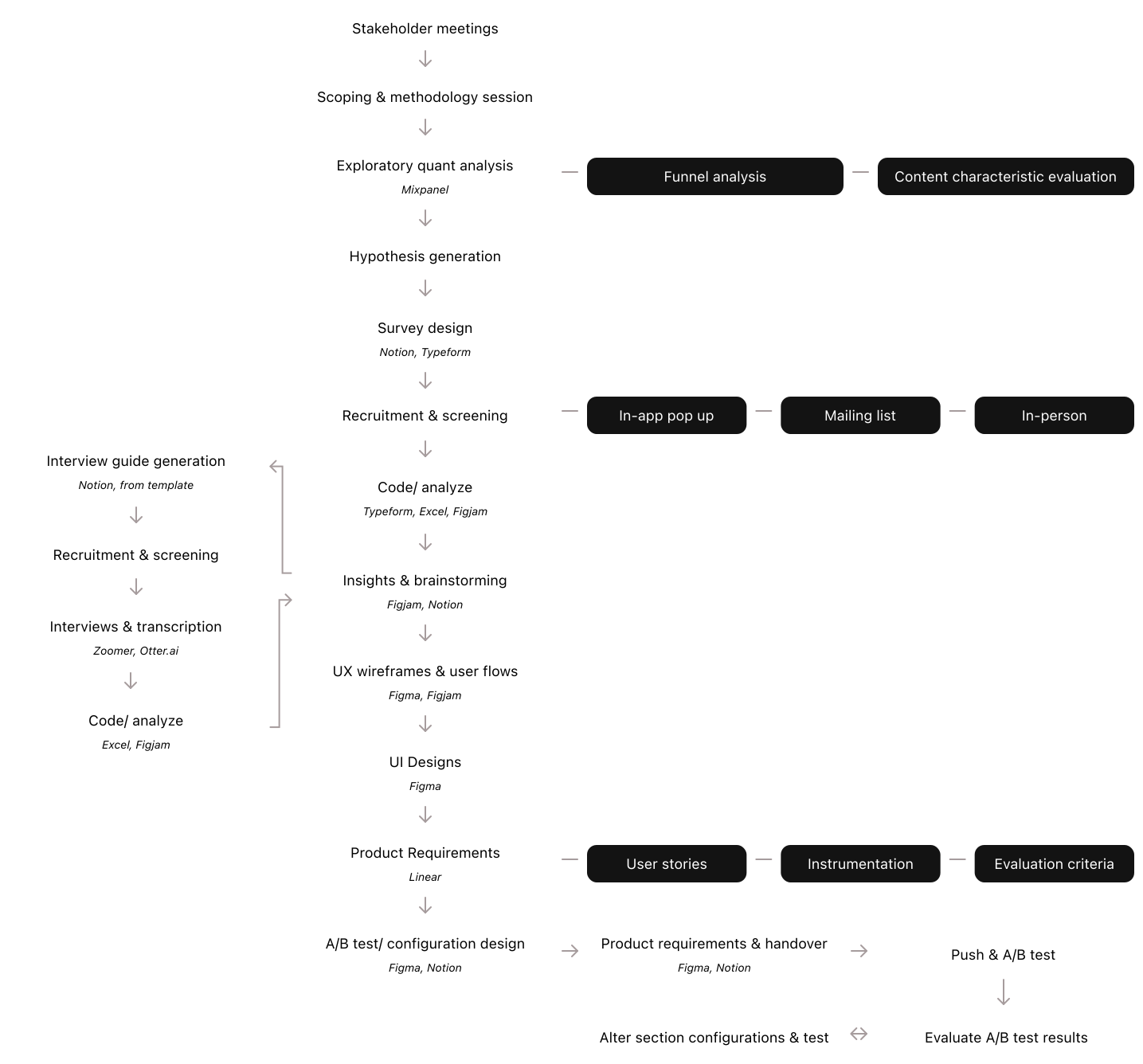
Through stakeholder meetings, I gathered a deeper understanding of our partners business goals and needs.

Through data analysis, I developed an initial understanding of users' in-app event creation and  discovery behavior.

Through interviews and surveys, I sought insight in to how users make plans both on and off the app - especially how they find and choose venues.

In synthesizing requirements and mixed-methods data, I created a clear picture of the overlap between business and user goals.

Process
Key insights
01

Images, proximity, & reviews are key factors

When looking for venues, users tend to look for this information to narrow their search.

02

Users need flexibility on what they decide first

The first decision in the organisational process fluctuates based on a variety of factors.

03

Monetized content should feel organic

Users don’t engage differently with content because it is sponsored — they engage differently when it feels out of context. Partner content needed to match the structure and intent of organic UGC

04

Strong segmentation between creators & non-creators

We want to target all users, not just existing creators. For this feature to have high top-of-funnel, it needs its own space outside of the even creation flow.

Ideation & synthesis
01

Insight-driven brainstorming

After researching, we developed a pool of possible solutions backed by our insights.

02

Affinity
Mapping

To synthesise our potential solutions, we thematically grouped them to combine overlapping options.

03

Development cost analysis

Finally, we compared expected dev costs to find the right balance of cost and potential benefit.

Experiment design

The solution needed to be a flexible system that allowed continuous testing of how monetized content was presented.

The structure would support purposeful variation such that key elements - user decision variables, content type, and level of user control - could be managed and evaluated over time.

This would make it possible to understand not just whether monetization worked, but under what conditions it aligned with user behavior and maintained engagement.

User flow & wireframing
Solution
01

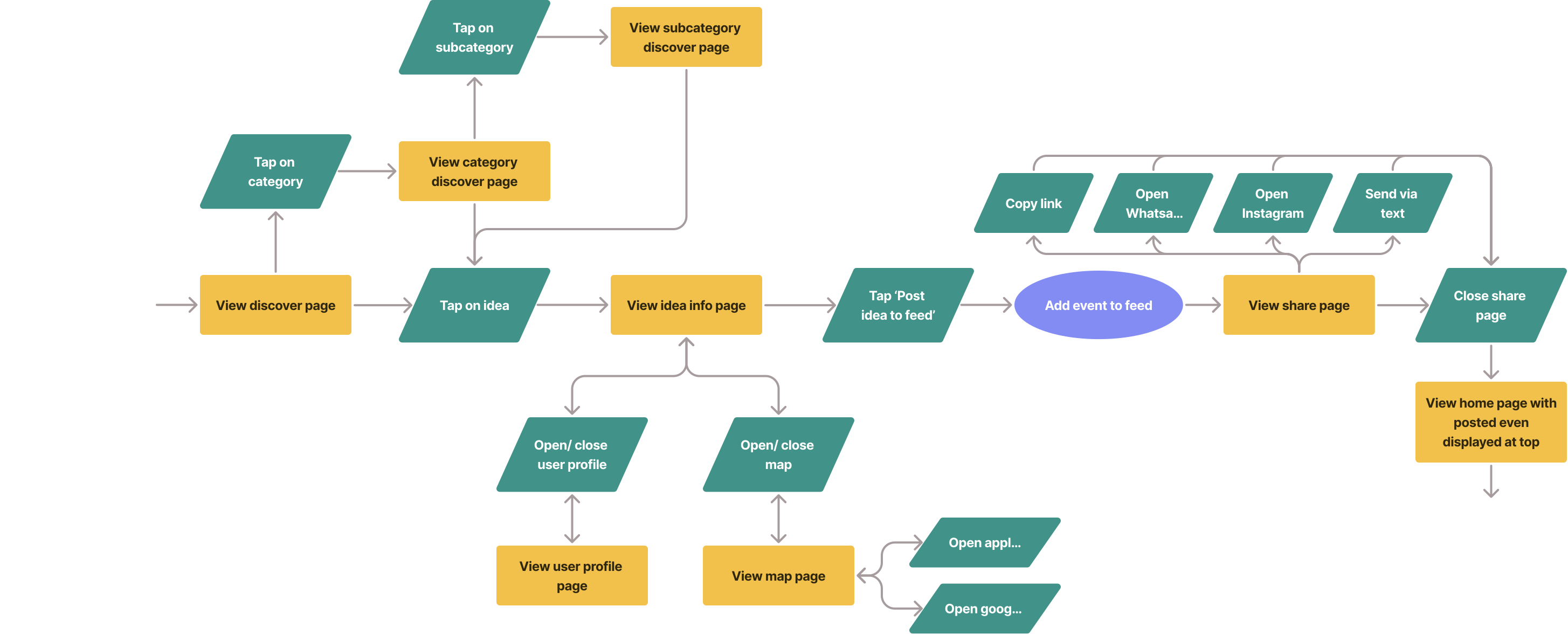
Step-by-step flow changed to a central hub with sub pages

To reduce the number of potential drop off points

02

All detail fields except the title are given defaults with optional editing

To reduce the number of barriers to posting

Wireframes
01

Detail options are grouped by importance

To incrementally encourage users to add detail optional without overwhelming them

02

A bottom sheet is used instead of a full page

To clarify the connection between the creation process and the home feed.

03

Most assets from the previous iteration are reused

To reduce development
cost and maintain our release cycle.

Solution
01

Step-by-step flow changed to a central hub with sub pages

To reduce the number of potential drop off points

02

All detail fields except the title are given defaults with optional editing

To reduce the number of barriers to posting

03

Detail options are grouped by importance

To incrementally encourage users to add detail optional without overwhelming them

04

Most assets from the previous iteration are reused

To reduce development
cost and maintain our release cycle.

04

Ideas use an alternate content format to the feed

To differentiate events from idea suggestions.

05

User-specific and activity-type categorisation are separated

To allow us to easily tailor the promotion of partner content to each user while still providing flow flexibility

01

User can view through user-specific or venue-type categories

To provide flexibility on decision ordering.

02

User-specific categorising is variable

To provide opportunities for testing.

03

Steps to post are minimised

To reduce drop off and simplify the process.

Interface

The key element of our chosen solution is it's flexibility for testing. With its own page, we're able to adjust the context and ordering in which we present the content without interfering with other features. Outside of testing, the feature provides suggestions in a clear and easily navigable way, allowing users to explore and find something they love quickly.

Testing decision-variables

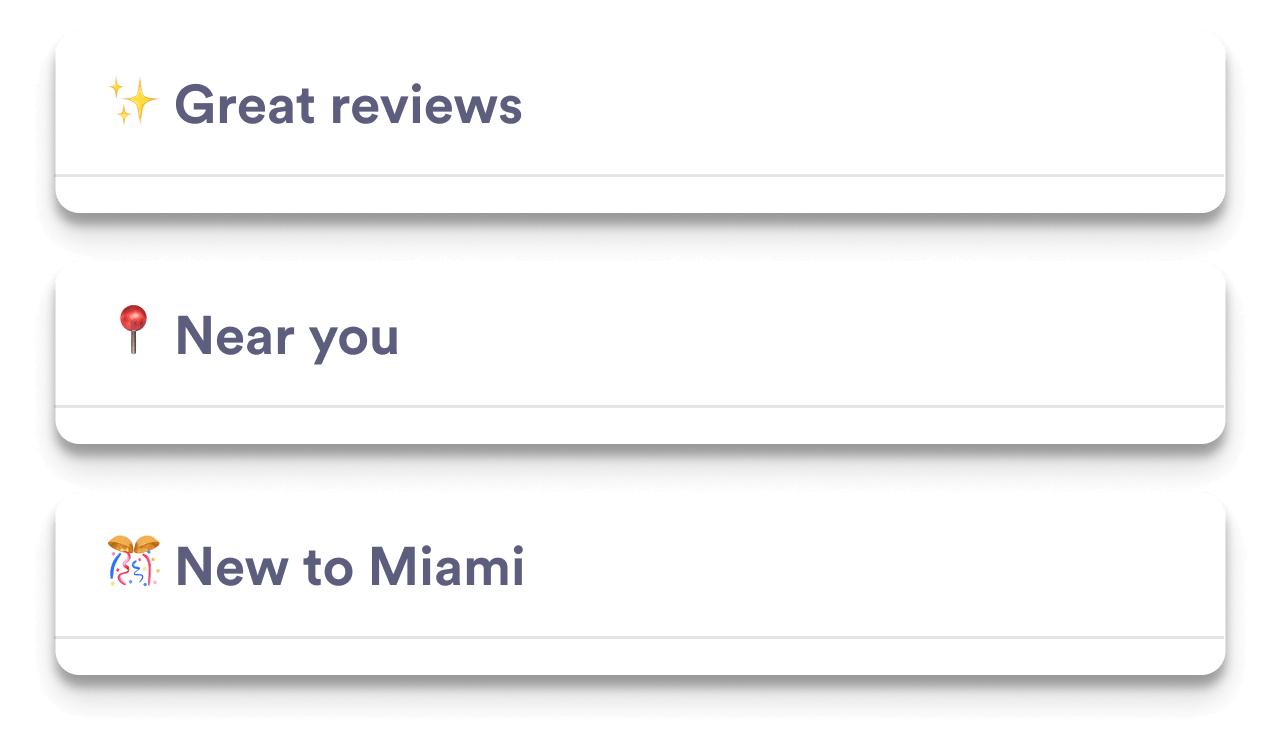
The discover page utilizes decision-variable grouping. Each section can easily be swapped out to create new combinations for  testing.

Testing categorization

In the case where users are looking for an idea that is specific to a type of activity, category filters are available at the top of the page. The ordering of these categories is flexible based on the types of activities we see the most demand for.

Key info is highlighted early

Based on our research, images, proximity, and reviews are the three strongest factors when deciding between venues. To help users make decisions faster, this info is clearly displayed on the outside of all suggestions.

User impact

Overall adoption

30%

Conversion to posting a partner-event within F30D

Converted adoption

78%

Conversion amongst existing UGC creators

Recurrence

65%

Repeat conversion to posting within F30D

Business & stakeholder impact

Organic UGC Parity

5%

Difference in engagement against organic UGC

Monetizable actions

28%

% increase in interactions with partner-sponsored content

Iterations
01

Merger with feed

Most users don't open the discover page frequently enough.

So, to further increase top of funnel and reduce the number of features the user needs to learn, we merged the discover page with the home feed.

02

Retaining idea originator

The cohort of users who have joined events created from suggestions, don't convert to creating from a suggestion any more frequently.

When a user creates an event from an idea, the source of the idea is shown alongside the user who turned it in to an event.