Role:
Founder, Product Lead
Duration:
4 months
Skills:
AI-enabled
0->1
product
development,
product
strategy,
customer
discovery,
MVP
prioritization,
technical
product
management,
experimentation
Languages:
Python,
TypeScript
(React
Native),
SQL
Status:
Launched
As Founder and Product Lead, I owned FiFi from initial opportunity discovery through App Store launch. I defined the product strategy and target customer, conducted user and market research, developed the business model, and translated early insights into a prioritized MVP roadmap.
I managed the product’s UX, technical architecture, and development, making trade-offs across output quality, processing speed, cost, and scope. I also established the product’s evaluation framework, using model-performance testing and user feedback to identify weaknesses, prioritize improvements, and guide subsequent iterations.

Customer
Social-media users who discover fashion through creator content
Problem
Identifying and buying clothes from social media content is hard, slow, and clunky
Product bet
Trigger visual product discovery directly from the native share sheet
Business model
Affiliate revenue from high-intent retail traffic & rich e-commerce attribution
MVP
iOS share extension, item detection, visual search, shopping results and search history
Delivery
Solo concept-to-launch ownership over four months
Technical result
86.5% end-to-end unique-item extraction F1 on 1,000 labelled videos
Product iteration
Post-funnel ratings marked “accurate” or “very accurate” increased from 73% to 79%
Social media platforms were not designed to support product identification or shopping outside of adverts. Users have a few slow & high-friction options if they want to find the item. Each additional step interrupts the moment of inspiration, and users frequently abandon the search before reaching a retailer.
The underlying problem is not a lack of purchase intent. It's the effort required to translate visual inspiration into an actionable product search.
Existing friction creates a gap between social-media discovery and e-commerce conversion. Existing creator-shopping platforms depend on creators tagging products, traditional marketplaces require users to know what they are searching for, and visual-search tools typically require them to manually extract and upload an image.
FiFi’s opportunity was in removing that investigation step. By allowing users to share content directly from the source platform, FiFi could return exact or visually similar products without requiring the user to describe, screenshot, crop, or search for them manually.
For consumers, this creates a faster and more natural route from inspiration to purchase. For retailers, it converts previously unaddressed demand into attributable, high-intent traffic through an affiliate model.
Interviews
“Every time I realize a video is an ad, I lose interest. It feels disingenuous.”
“I follow a lot of fashion accounts but it’s so hard to figure out where things are from... especially if <the creator> doesn’t reply in the comments.”
“I get really bored of sifting through fashion websites for things I like.”
“I end up screenshotting to search for similar items but it’s annoying getting the right bit of the video.”
“If I see an item I like on Insta, I usually give up if I can’t find it quickly.”

LTK
10M+ downloads
4.9
LTK allows influencers to create on-platform shoppable posts and videos, linking directly to the products.
Advantages:
- Short-form video fashion discovery
- Established creator ecosystem
- Mature monetization infrastructure
Disadvantages:
- Can’t discover fashion from content on other platforms
- All content framed as adverts

ShopStyle
500k+ downloads
4.9
ShopStyle aggregates products from retailers and provides a traditional e-commerce search and browsing interface.
Advantages:
- Extensive retailer catalogue
- Familiar e-commerce UX
Disadvantages:
- Users must search based on pre-existing intent
- Doesn’t support visual search

Shoppin
Unknown downloads
4.7
Shoppin enables users to discover clothing items through reverse image search and digitally try them on using AI.
Advantages:
- Supports visual search based on inspiration images and trends
- Allows users to visualize outfits before buying
Disadvantages:
- Doesn’t support video content
- Requires manual image upload
Observation:
LTK makes creator content shoppable but depends on deliberate creator tagging.
Implication:
FiFi should work on ordinary, non-sponsored content.
Observation:
ShopStyle offers broad retailer coverage but requires users to formulate a search.
Implication:
FiFi should convert visual inspiration into search results automatically.
Observation:
Visual-search products support images but introduce screenshot and upload friction.
Implication:
FiFi should remain inside the social-media share flow.
Fashion-focused online shoppers who follow and discover outfits from social media content.
High-intent
Mobile-first
Content-engaged
Scrub & screenshot
Users often scrub, pause, take screenshots, and attempt standard reverse image searches.
Comment section search
Many rely on comment sections to identify brands or items, yet the creator often fails to reply.
Text search
When the exact item cannot be identified, users search for similar items using vague descriptors like: “oversized jacket”.
Give up or forget
Friction often stops users from actively searching at the time, opting instead to keep an eye out next time they’re shopping.
Shop the inspiration without the investigation.
See clothing on social media post
Share content through share sheet
Receive products & alternatives
High purchase intent
- social
media
provides
the
inspiration
and
purchase
intent.
Clear value
- skips
numerous
cumbersome
investigation
steps.
Familiar user behavior
- content
sharing
is
an
existing
behavior
for
the
target
segment.
Maintains momentum
- results
in
seconds,
not
minutes.
Affiliate linking
- most
results
can
be
swapped
for
affiliate
links
using
Sovrn
Commerce.
Attributable purchases
- purchases
can
be
linked
to
their
inspiration.
Growth loop
Affiliate revenue from users purchasing via FiFi will be passed on to the creator of the shared content, facilitating revenue-sharing and growth partnerships.
Revenue engine
Rich attribution data will be passed on to the e-commerce site - platform, video, & creator - supporting new insight into what made their items stand out & what creators to partner with.
Meet users at the moment of inspiration
Start from the social-media share sheet rather than expecting users to open another app.
Minimize investigation
Detect and organize clothing automatically rather than requiring users to crop screenshots or write descriptions.
Keep inference economically viable
Prefer a deterministic pipeline and targeted models over expensive LLM calls.
Preserve purchase intent
Minimize the time between seeing an item and viewing shoppable results.
Partner with creators early
Rather than taking advantage of creators' content, bring them in to help grow the platform.
Building FiFi required balancing the ideal user experience against the constraints of an early-stage product. I prioritized decisions according to four criteria:
The goal of the MVP was not to build a complete fashion-shopping platform. It was to prove that FiFi could reliably shorten the journey from seeing an outfit to finding useful products.
All content type support vs. single-type
Supporting all content types (video, carousel, image) supports a wider use case and avoids users hitting errors across different content types
A single content ingestion and processing path reduces complexity
Decision:
Only
support
video
ingestion.
Frame coverage vs. processing cost
Too few frames risks missing items
Too many frames increases latency, compute requirements and duplicate detections
Decision:
Minimize
the
number
of
sampled
frames.
Duplicate removal vs. item preservation
Aggressive deduplication removes more repeated detections but risks merging genuinely different items.
Conservative deduplication protects distinct items but leaves more duplicates in the output.
Decision:
Maintain
at
least
95%
deduplication
precision,
then
tune
post-processing
logic
to
maximize
deduplication
recall.
Symbolic vs. LLM-heavy architecture
A symbolic architecture increases pipeline complexity but improves consistency and reliability while reducing per-run processing time & cost
An LLM-based architecture provides strong inference without complex logic but increases per-run time, cost, & output variability
Decision:
Build
a
symbolic
architecture.
Exact matches vs. similar products
Exact matches are ideal; however, many items are no longer available online - particularly vintage, custom, or previous season items
Similar products may not match the user's inspiration exactly; however, they ensure the user gets a purchasable result based on what they're looking for
Decision:
Show
exact
matches
first
when
available
followed
by
similar
results.
iOS & Android vs. single-platform support
Supporting iOS & Android expands the potential userbase but greatly increases workload during a highly experimental build period
Single platform support reduces the potential userbase but streamlines thesis validation
Decision:
Build
primarily
in
react
native;
however,
begin
only
with
iOS
support
due
to
platform-specific
share
sheet
differences.
Native share-sheet entry
Video ingestion
Minimized frame sampling
Open-source detection model integration
Precision thresholded symbolic deduplication
Visual product search: exact if available then similar
Viewable search history
Affiliate-linked shopping results
User accounts
Multi-modal search
Personalized recommendations
Social features
Retailer integrations
Virtual try-on
Android support
Video ingestion
Apify API
Intelligent frame sampling across variable video styles
Solution:
Utilize
video-incongruence
signals
to
detect
scenes
then
use
scenes
as
a
proxy
for
outfit
changes,
sampling
1-3
times
depending
on
scene
length
to
ensure
a
clear
image
of
each
item
is
captured,
Technical challenge
Accurate clothing detection from still frames
Open-source model with fashion weights
High precision, high recall (high F1) deduplication of detected items
Solution:
Leverage
scene
distinctions
to
aggressively
deduplicate
within-scene
then
compare
each
item
group
in
matrices.
Technical challenge
Accurate reverse image search
SERP API
Friction:
Users
had
to
exit
and
navigate
to
a
separate
platform
to
search
for
items.
Decision:
Make
the
iOS
share
sheet
FiFi's
primary
entry
point.
Outcome:
Users
can
share
videos
directly
to
FiFi
and
view
results
without
navigating
to
a
new
space.
Friction:
Users
had
to
scrub,
screenshot,
crop,
each
item
they're
interested
in.
Decision:
Extract
and
display
each
unique
item
from
the
video.
Outcome:
Users
can
tap
on
any
item
they're
interested
in
to
immediately
start
a
search.
Friction:
Users
often
forgot
about
their
inspiration
or
left
them
in
their
saves
with
no
recourse.
Decision:
Display
a
history
of
all
processed
videos
and
searched
items.
Outcome:
When
users
open
the
FiFi
app,
they
can
jump
straight
back
to
searching
for
their
items.
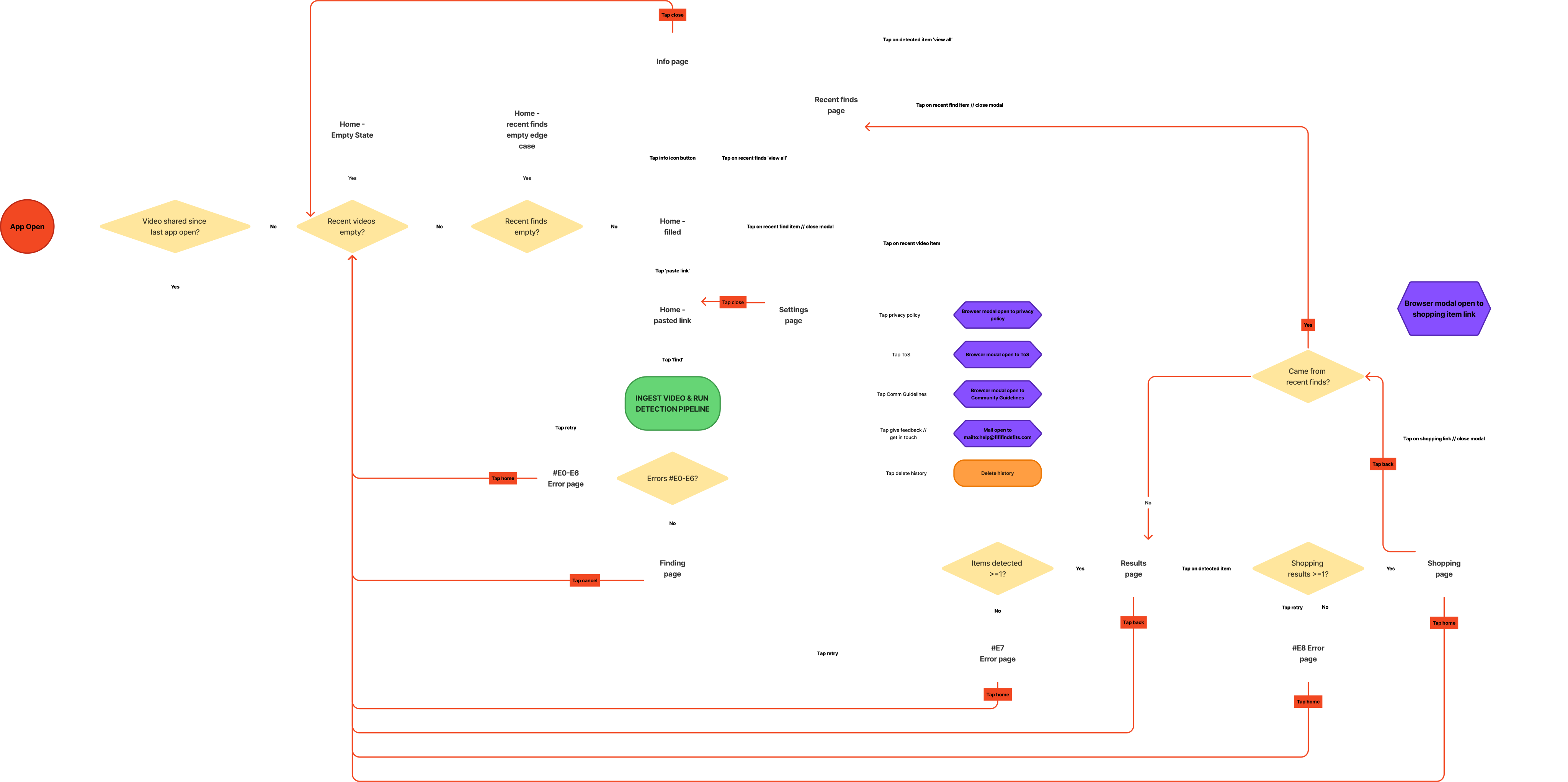
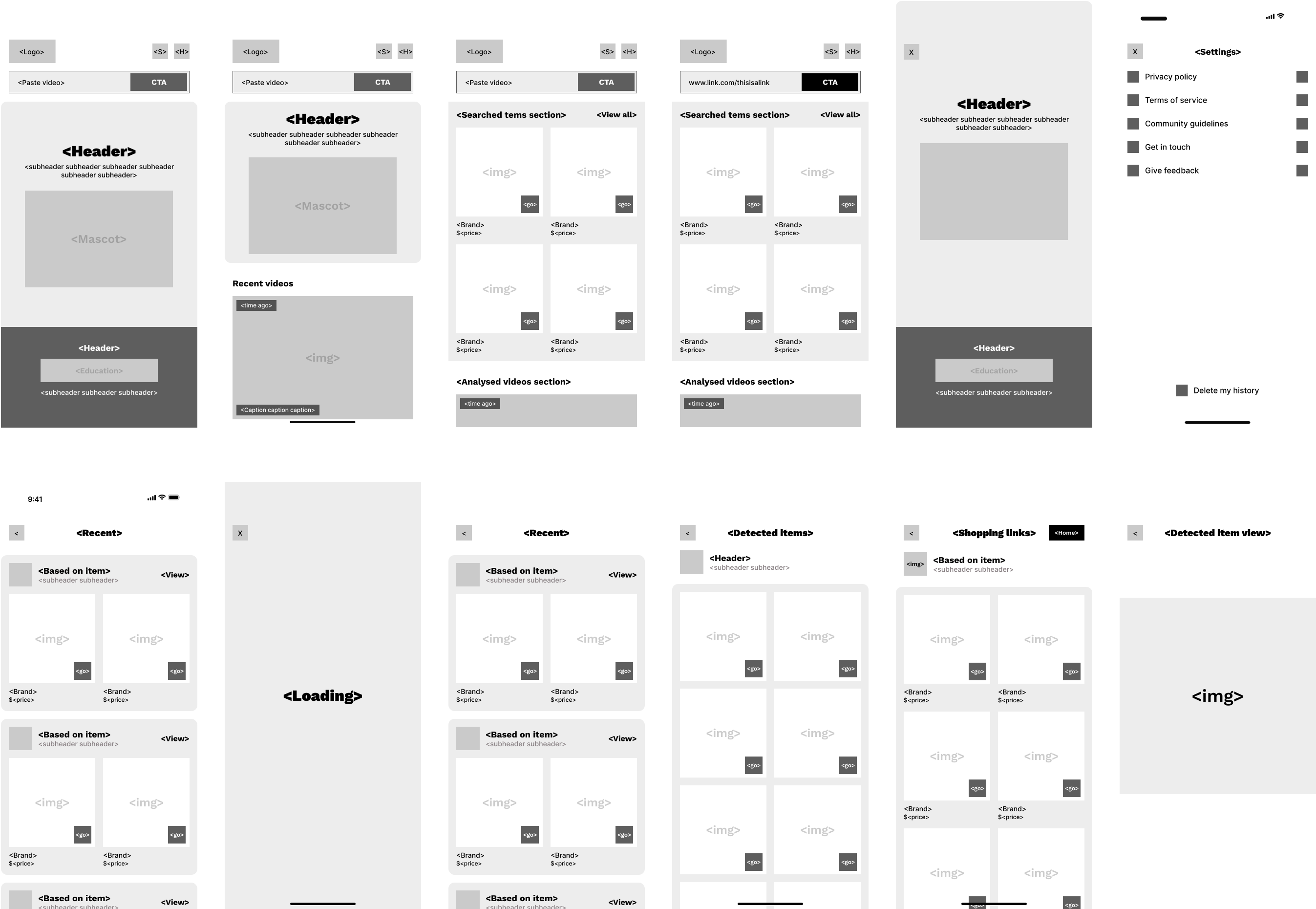
In addition to the core share-sheet flow, the accompanying in-app experience supports link-pasting as a back up and provides a basic foundation for testing new features beyond MVP scope.
The MVP information architecture is simple, focusing on:
Leveraging empty states to educate new users
Hierarchical navigation into & out of core flows
Basic provision of required controls and legal information
33 beta testers over 4 weeks
In-app perceived-accuracy modal pop up (260 responses)
Beta tester interviews at week 2 (n=6) and week 4 (n=5)
Three iterations released in week 3
Signal
Beta users reported difficulty in finding the item they were looking for amongst the list of item detections.
Iteration
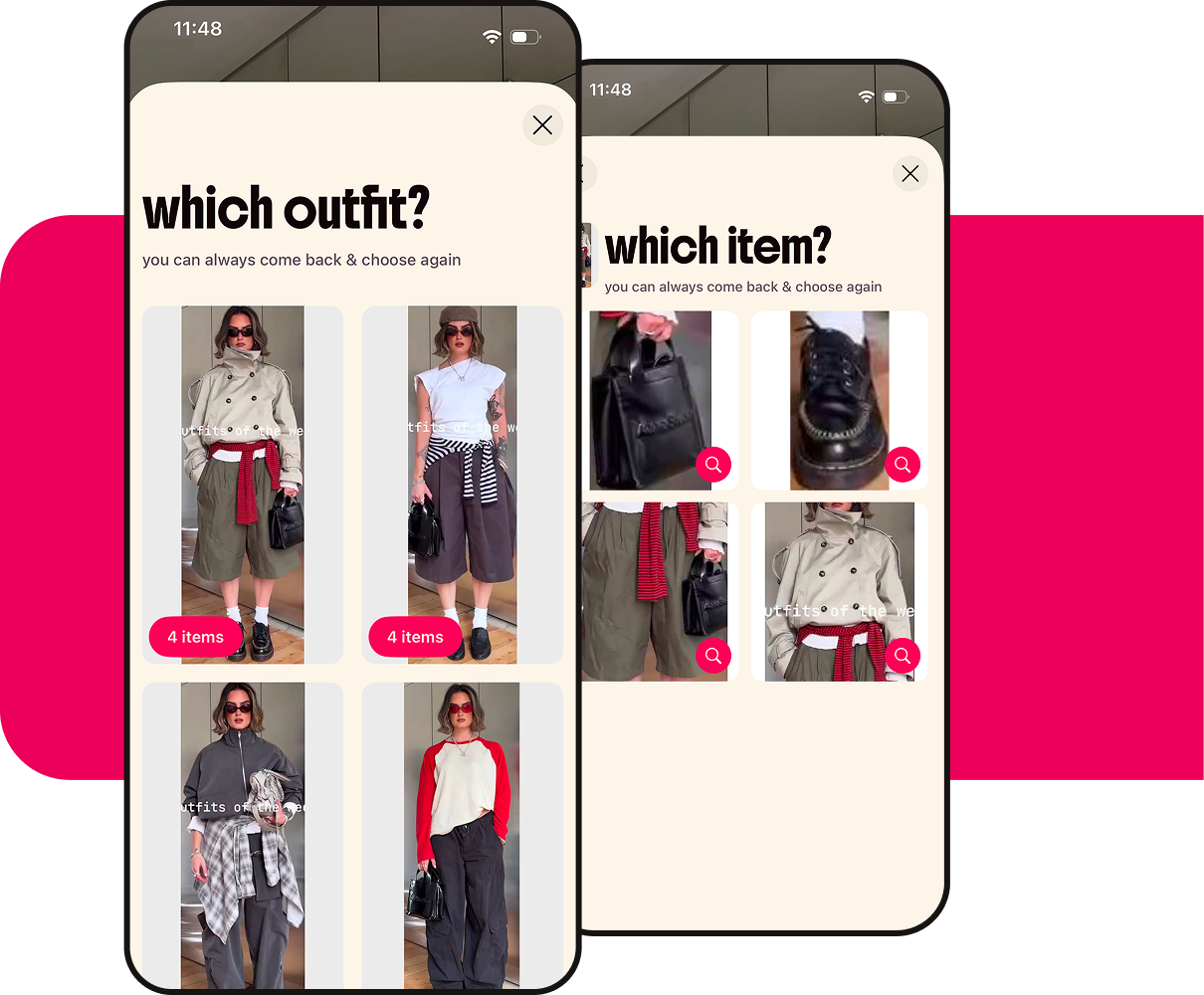
Added person detection (sensitive to outfit differences) and restructured output architecture to group items by outfit.
This had the added benefit of reducing deduplication strain as the pipeline no longer needed to make comparisons across different outfits.
Post-release observation
The share of post-funnel ratings marked “accurate” or “very accurate” increased directionally from 73% to 79% between weeks 1 & 2 (n=111) and weeks 3 & 4 (n=149) following the week 3 release.
Grouping outputs by outfit reduced the scope of deduplication from the entire video to each individual outfit. On the same manually labelled 1,000-video evaluation set, end-to-end unique-item extraction F1 increased from 81.0% to 86.5% under the new outfit-scoped output structure.
Signal
Beta users reported frustration in seeing error messaging when sharing non-video content.
Iteration
Added image and carousel support, treating images as sampled frames within the existing pipeline.
Post-release observation
17% of shares in week 3 and 4 (25 of n=149) were images or carousels after adding support for these content types in week 3.
Signal
Beta users reported being unaware of the ability to share from the source platform's share sheet.
Iteration
Added tutorial buttons that navigate to a source platform and overlay (picture-in-picture) an educational video as they share from the share sheet for the first time.
Post-release observation
Interviewed beta testers responded positively to the new education flow with 4 of 5 stating it improved clarity.
FiFi's pipeline has five phases:
Each stage provides contextual information to the next, relying on open-source AI and logical inference to minimize compute. This avoids expensive LLM calls entirely while achieving an 86.5% end-to-end unique-item extraction F1 against a data set of 1,000 labelled videos. This deterministic approach also improves consistency and reduces processing time. Between the first pipeline version and this iteration, processing time decreased from 16 seconds to just 4.5 seconds for the same 40 second video.
Revisit your searches and videos
Choose which outfit you're interested in
Choose which item you want to shop for
Compare stores, prices, and variations
Building FiFi reinforced that strong product decisions often come from reshaping the problem, not simply improving the underlying technology. By narrowing the initial use case, treating model constraints as fixed inputs, and iterating from real user behavior, I was able to improve both system performance and usability without expanding the product unnecessarily.
The next challenge is validating whether early utility translates into sustained retention, retailer conversion, and a scalable business model.