I
led
the
development
and
validation
of
a
venue-discovery
experience
that
turned
sponsored
venues
into
useful
event
ideas,
testing
new
partnership
opportunities
while
maintaining
engagement
with
user-created
events.
Role:
UX Lead
Duration:
4 weeks from discovery to MVP validation
Skills:
Product
analytics,
interviews,
surveys,
A/B
testing,
UX/UI,
PRDs,
post-release monitoring
Tools:
Figma,
Figjam,
Mixpanel,
Zoom,
Typeform
OneSignal
As UX Lead, I owned the project from opportunity framing through MVP validation. I translated growth and partner requirements into product hypotheses, led the research and solution-prioritization process, designed the experience, and worked with engineering and growth to launch and evaluate a configurable MVP within six weeks.
My responsibility was not simply to design a new venue-discovery interface. It was to determine whether partner venues could be integrated into Clyx in a way that created genuine user value and warranted further commercial investment.

Clyx had identified partner-sponsored content as a revenue stream. Event promotion fit naturally within the app because events were already its primary form of discoverable content. However, event-only promotion restricted the opportunity to partners running activities at specific dates and times.
Many prospective partners wanted ongoing visibility for their venues. Supporting this would expand the inventory Clyx could offer, but inserting conventional advertising into a user-generated content experience risked reducing relevance and trust.
How can we create a sponsorable venue-discovery experience that's in line with how users already make plans while maintaining engagement parity with organic UGC?
Many prospective partners wanted ongoing visibility for their venues. Supporting this would expand the inventory Clyx could offer, but inserting conventional advertising into a user-generated content experience risked reducing relevance and trust.
In scope
Testing whether partner venues could provide useful planning inspiration
Connecting venue discovery to Clyx’s event-creation loop
Evaluating where and how partner content should appear
Building a configurable MVP that could support continued experimentation
Measuring initial adoption, repeat use, and downstream event engagement
Out of scope
Selling the feature to partners
Developing pricing or billing models
Building partner campaign-management tools
Measuring revenue or return on advertising spend
Defining long-term partner and revenue operations
20%
Adoption
At least 20% of activated users entering the experience would publish an event using a partner venue.
50%
Recurrence
At least 50% of converted users would publish a second partner-venue event within 30 days.
Parity or higher
Events created with partner venues should achieve average engagement equal to or greater than purely organic user-generated events.
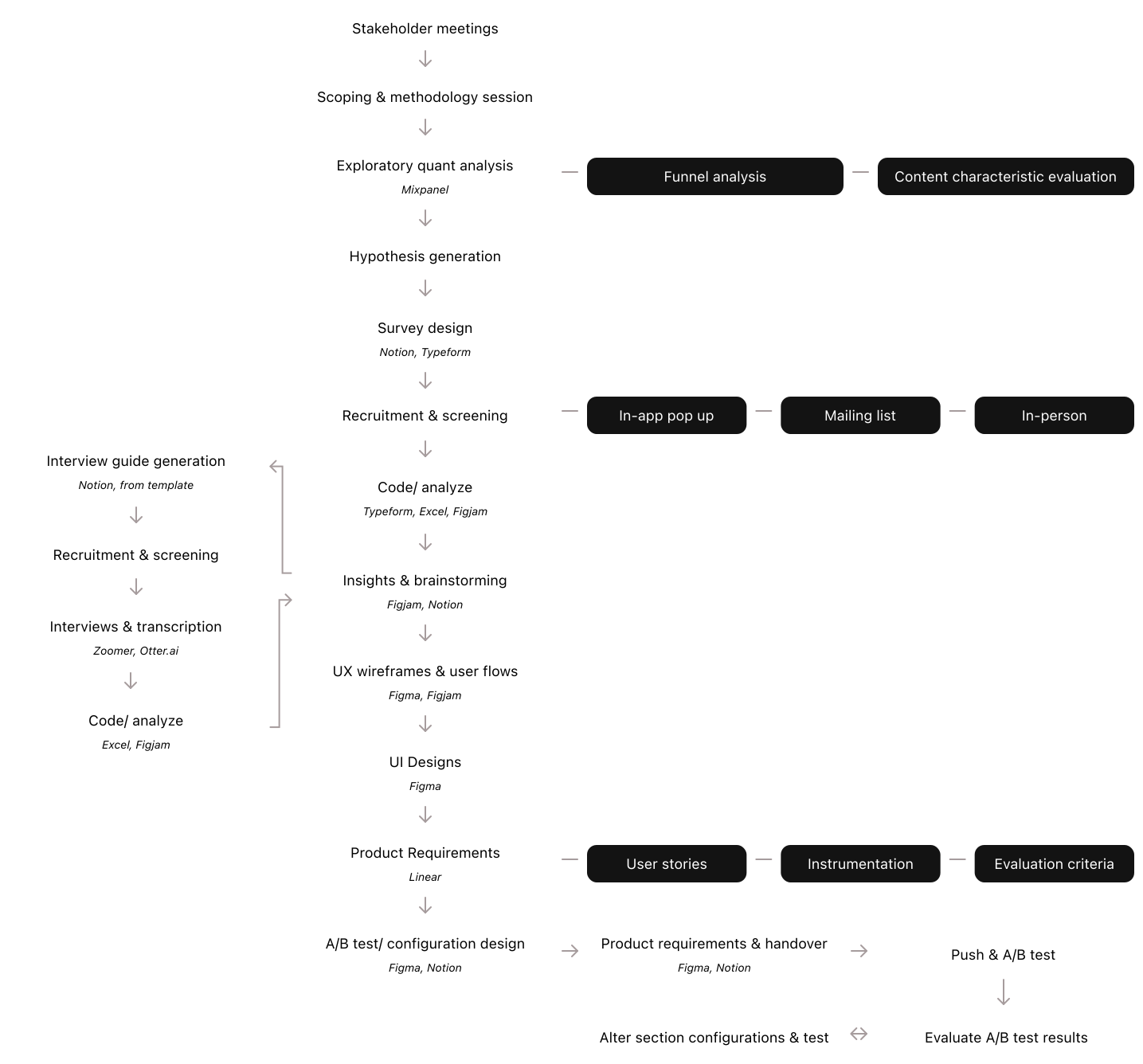
I combined stakeholder input, product analytics, interviews, and surveys to answer three questions:
What partner requirements would the feature need to support?
How did users currently find venues and organize plans?
Where could venue suggestions add utility without disrupting existing behavior?
Conversations with existing event partners clarified the prospective business value: partners wanted sustained venue visibility in addition to promotion of time-bound events.
Ranking
Decision-relevance of event variables
Likert scale
Demand for venue and activity inspiration
Likert scale
Willingness to post with pending event details
Likert scale
Desirability of example event suggestions
How do users approach organizing events outside of Clyx?
Which decisions are made first in the planning process?
How do users feel about sponsored content on Clyx and why?
What makes an app-based suggestion feel useful and trustworthy?
From surveys
Users evaluate venues through a small set of high-signal details
Images, proximity, and reviews were the strongest inputs users relied on when narrowing their venue options.
Implication:
Surface
this
information
on
suggestion
cards
so
users
could
assess
ideas
without
repeatedly
opening
venue-detail
pages.
From interviews
Planning does not follow a single sequence
Users did not consistently begin with the same decision. Some started with an activity, while others began with a venue, location, or time.
Implication:
Organize
suggestions
around
a
variety
of
planning
variables.
From interviews
Contextual relevance mattered more than sponsorship alone
Interviewees did not reject suggestions simply because they were sponsored. Negative reactions were more closely associated with content that felt irrelevant, disruptive, or disconnected from what they were trying to do.
Implication:
Partner
content
should
use
interaction
patterns
consistent
with
Clyx's
existing
experience
while
remaining
identifiable
as
partner
content.
From exploratory usage data analysis
Placing the feature exclusively inside creation would restrict its reach
Product data showed a clear distinction between users who already created events and those who primarily browsed or joined them.
Implication:
Give
venue
inspiration
its
own
discovery
surface
that
could
reach
creators
and
non-creators.
We considered three principal ways to introduce partner venue suggestions:
Main-feed placement
High visibility.
High risk of disrupting organic event discovery.
High risk of reducing feed relevance & social proof.
Creation-flow placement
Strong contextual relevance.
Only reaches users who had already decided to create an event.
Standalone discovery experience
Reaches creators & non-creators.
Protects existing feed.
Controlled environment for testing.
Requires users to navigate to a new page.
As the commercial model remained unproven, we designed the MVP as a learning system rather than a fixed advertising product.
The standalone page was composed of modular sections that allowed the team to vary:
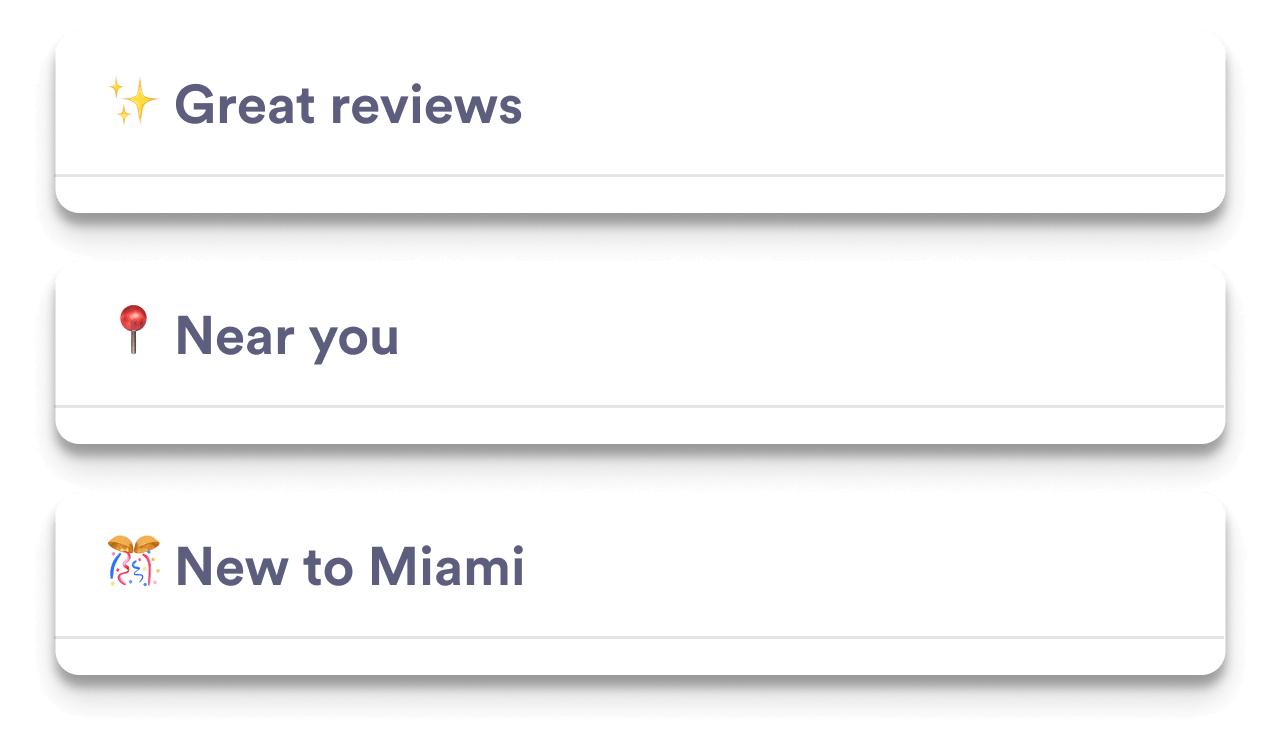
The planning variable used to group suggestions
The types of venues and activities presented
The ordering of content
The amount of event information already defined
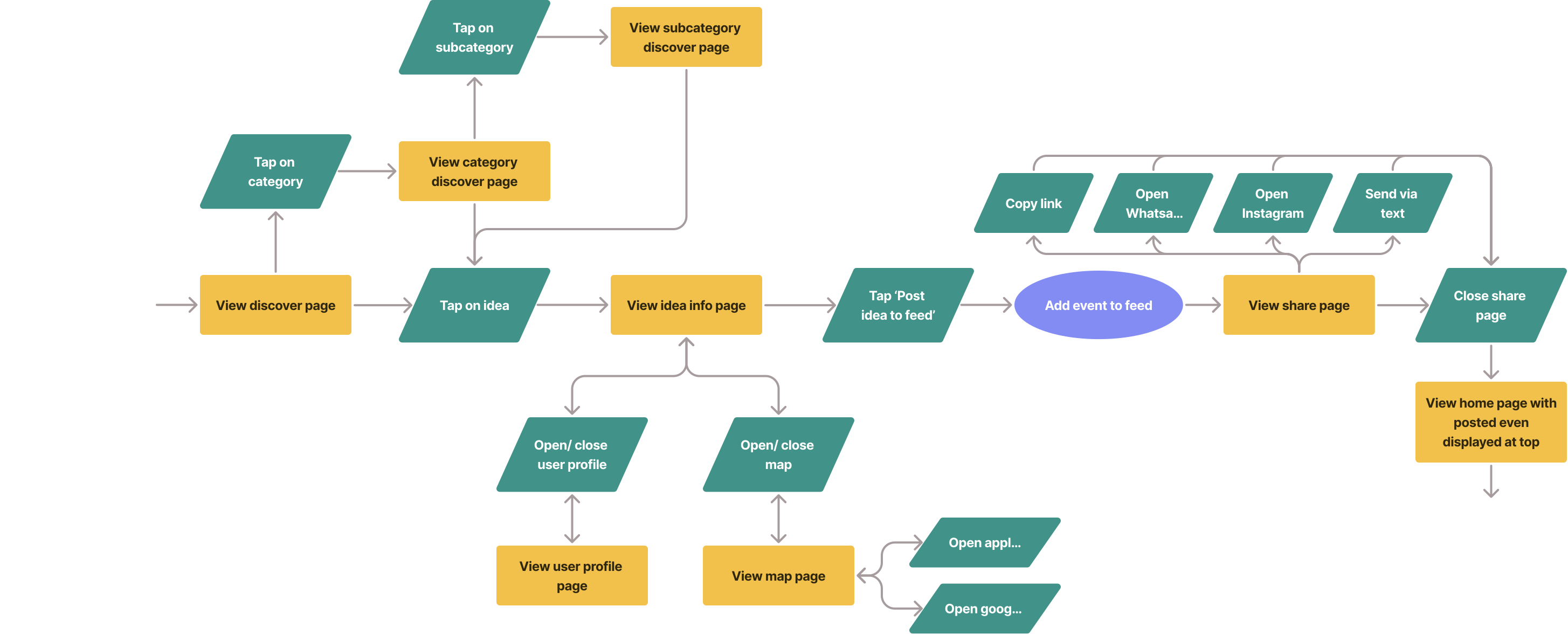
Browse venue and activity ideas
Narrow suggestions using planning variables or categories
Evaluate using key information
Select a suggestion
Post the event
Finalize outstanding event details with group
.png)
The selected solution was a standalone page built for both user utility and continued experimentation.

Testing planning starting points
The discover page utilizes decision-variable grouping. Each section can easily be swapped out to create new opportunities for testing.
Activity-led browsing
Category filters supported users who knew the kind of activity they wanted to organize but had not selected a venue. The ordering and composition of categories could be adjusted in response to observed demand, creating another route for testing.


Reducing evaluation effort
The three most relevant decision variables - images, proximity, and reviews - were displayed directly on suggestion cards. Users could also open a suggestion to see the full details.
We released the feature to the full user base and used its modular structure to vary planning starting points and category positioning and grouping. Over the first 30 days, we measured conversion to partner-venue event creation and downstream engagement relative to organic events. We additionally measured repeat creation up to an additional 30 days after the original creation instance.
Adoption
22%
Conversion amongst MAUs to posting a partner venue through the new surface.
Recurrence
42%
Conversion amongst MAUs to posting a second partner venue in the subsequent 30 days.
Parity
+3.6%
Higher avg. event engagement against purely organic UGC
This project reinforced that monetization should not begin with deciding where to place advertising. It should begin by identifying a genuine user need that a commercial partner can help satisfy.
By treating partner venues as useful inputs to the planning and creation experience, we identified a potential revenue surface that complemented Clyx’s core product behavior rather than competing with it.