

Optimizing
sustainable
food
behavior
@

Role:
Behavioral Science MSc Consultant
Duration:
6 months
Skills:
Quant
methods,
Qual
methods,
behavioral
diagnosis,
triangulation
Languages:
R
Tools:
R Studio, Kumu, Teams, Excel,
Role:
Behavioral Science MSc Consultant
Duration:
6 months
Skills:
Quant
methods,
Qual
methods,
behavioral
diagnosis,
triangulation
Languages:
R
Tools:
R Studio, Kumu, Teams, Excel,
For my MSc Behavior Change research dissertation at University College London, I partnered with Reewild (now Vela) to evaluate and optimize their Planet Points sustainability rewards scheme.
Using the Behavior Change Wheel framework, I conducted a mixed-methods study combining:
- Quantitative analysis of point-of-sale transaction data
- A behavior change technique (BCT) audit of the intervention
- Qualitative interviews with program participants
Food production is one of the largest contributors to global greenhouse gas emissions. Yet, environmental consequences are often abstract, delayed, and difficult to interpret.
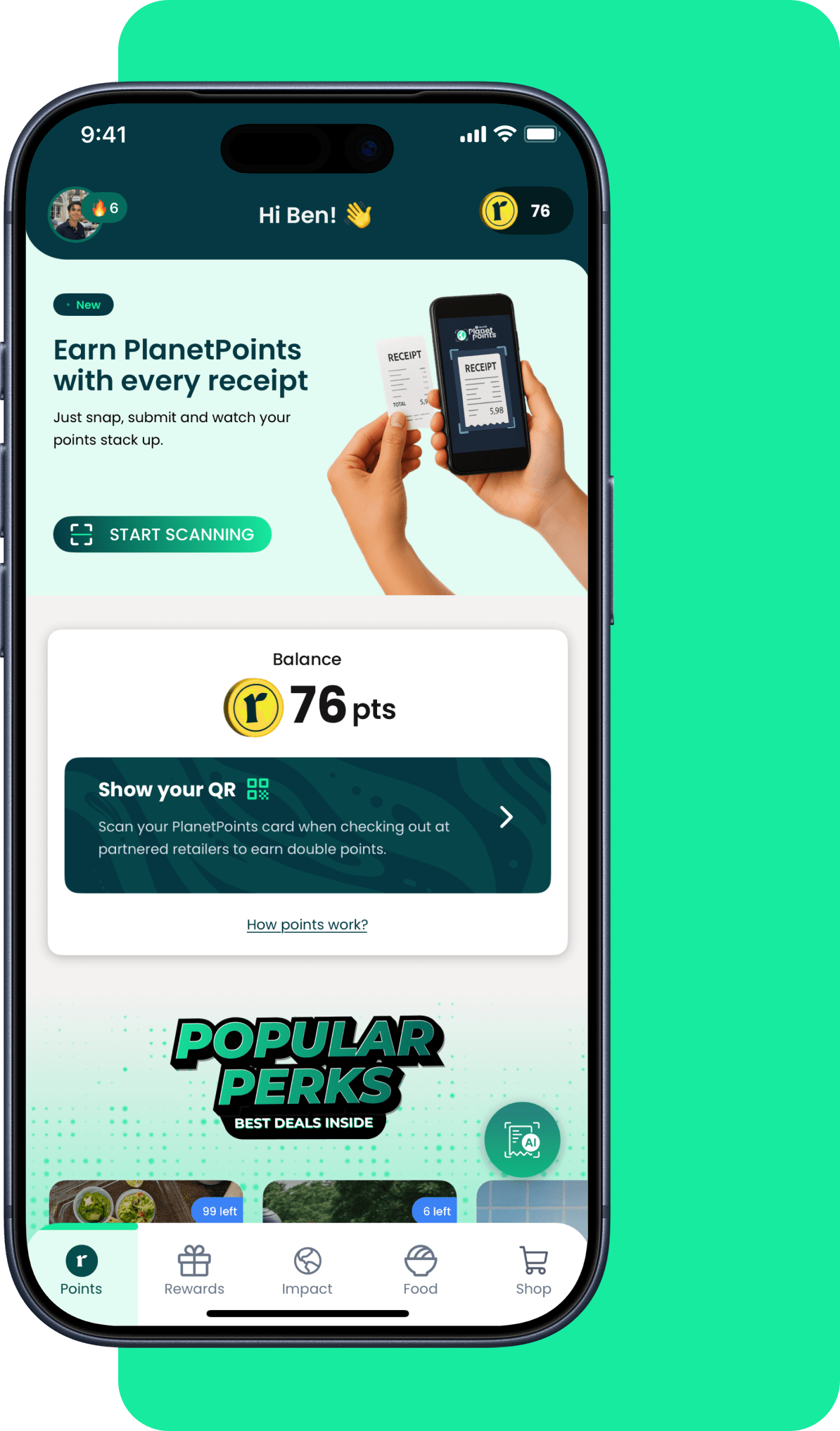
Reewild (now Vela) created Planet Points to reward users for purchasing lower-impact food and drink options. Users receive points per £ spent depending on the eco-rating (A-E) of their choices
Most consumers care about the environment, but this rarely translates into consistent sustainable decision-making.
So, can rewards and behavioral nudges truly shift food purchasing behavior?
If so, how can we maximize that influence?
Impact
Does participation in the Planet Points program influence food purchasing behavior?
Mechanisms
Which behavior change techniques are implemented within the intervention?
Barriers & enablers
What behavioral barriers and enablers influence engagement?
Optimization
How can the intervention’s efficacy be improved?
POS quantitative analysis
Point-of-sale data from 187,000+ transactions were analyzed through a difference-in-difference econometric model to quantify the impact of Planet Points on purchasing behavior.
Behavior change technique (BCT) audit
185 unique components of the UI, messaging, and in-person experience were audited against the BCT Taxonomy (BCCTv1), identifying 10 integral and 14 subsidiary BCTs.
Triangulation
Findings from the quantitative analysis, BCT audit, and participant interviews were synthesized using the Behavior Change Wheel framework.
This triangulation allowed behavioral outcomes, intervention components, and participant experiences to be evaluated together, generating a clear diagnosis of how and why the intervention influenced behavior.
The combined evidence was then used to identify a series of informed recommendations to optimize the Planet Points scheme.
Participant interviews
15 45-minute interviews were conducted. Interview schedules were generated based on the components of the Theoretical Domains Framework. Transcript data was analyzed using the COM-B model, mapping behavioral barriers and enablers across: capability, opportunity, and motivation.
Which behavior change techniques are implemented within the intervention?
Integral
Feedback on outcome(s) of behavior
Instruction on how to perform the behavior
Information about social and environmental consequences
Prompts/ cues
Material incentive (behavior)
Incentive (outcome)
Reward (outcome)
Conserving mental resources
Adding objects to the environment
Subsidiary
Feedback on outcome(s) of behavior
Instruction on how to perform the behavior
Information about social and environmental consequences
Prompts/ cues
Material incentive (behavior)
Incentive (outcome)
Reward (outcome)
Conserving mental resources
Adding objects to the environment
Does participation in the Planet Points program influence food purchasing behavior?
For hot meals
17 pp
increase
in
target
behavior
Planet Points increased the likelihood of choosing low-carbon hot meals by 17 percentage points, showing stronger behavioral effects in high-emission food categories.
With eco-labels on menus
11 pp
increase
in
target
behavior
When eco-labels were displayed on menu cards, sustainable purchases increased by 11 percentage points, suggesting visible prompts significantly influence decisions.
What barriers and enablers influence engagement?
Value Framing
Users associated sustainability with health and ethics, suggesting wider value framing could strengthen motivation.
“For me, it's more of a health choice rather than a sustainable choice.”
Rating tangibility
Eco-ratings were understood at a high-level but left user wondering what the actual tangible impact of there decisions were.
“It would be really nice to be able to see what the impact actually is”
Reward schedule
Users often could not accumulate enough points quickly enough to redeem rewards, weakening motivational impact.
“it took so long <that I> gave up on trying to redeem again”
Category context
Effects were stronger in high-impact food categories where differences between options were more intuitive.
“I know that meat production is terrible and that I should not eat it.”
Knowledge gaps
Many users underestimated the impact that an individual’s food and drink choices can have on the environment.
“I don't know how much of an impact I as an individual can make”
Recall friction
Participants frequently forgot to scan their Planet Points card at checkout, reducing engagement with the intervention.
“I think it’s easy to forget and maybe there could be more advertising for it.”
Reward Motive
Points reinforced sustainable behavior when users had a particular reward goal but failed to do so in lieu of a desired reward.
“I feel actually is motivates me to use more of this app”
Social proof
Users indicated stronger engagement with peer participation, suggesting social norms could reinforce adoption.
“When you see people using it you think... I'm generating more of an impact”
How can the intervention’s efficacy be improved?
Frame sustainable choices within broader value narratives (e.g., health, ethics) rather than environmental outcomes alone.
Adapt BCT: Information about social and environmental consequences
Translate impact ratings into relatable environmental equivalents (e.g., “choosing A over C saves as much CO₂ as 10 plastic bottles”).
Adapt BCT: Information about social and environmental consequences
Calibrate the reward schedule so users can earn their first reward quickly, experience the ah-ha moment, and start engaging more deeply.
Adapt BCT: Reward (outcome)
Prioritize engagement in high-emission categories where differences between choices are most salient and have higher environmental impacts.
Adapt BCT: Conserving mental resources
Provide clearer educational cues explaining how individual purchasing decisions contribute to environmental impact.
Adapt BCT: Information about social and environmental consequences
Remove the need to scan at checkout and instead leverage institutional partnerships to link users’ payment cards.
New BCT: Environmental restructuring
Calibrate reward thresholds and expand the reward pool to maximize the number of users pursuing a meaningful reward goal.
Adapt BCT: Material incentive (behavior)
Introduce social proof signals from other users, highlighting participation and the collective environmental impact of the user base.
New BCT: Information about others’ behavior
"Your data analysis and recommendations from the UCL pilot have genuinely been invaluable.
We’ve used it extensively in joint external communications with Mastercard, and was also central to testing the new emissions avoidance framework developed by the World Resources Institute and the World Business Council for Sustainable Development.
Your work has also played an important role in our sales efforts. The evidence base from the pilot has helped underpin several upcoming partnerships, including deals with a large global food conglomerate, a major UK retailer, and a new collaboration with a world-renowned university."
Kit Nicholl - COO of Vela (Prev. Reewild)